
MitchelLake Intelligence
Talent Market Index
A live observatory of hiring conditions for executive talent — data refreshed three times daily; the headline index moves weekly as each data week completes.
MitchelLake proprietary market data · powered by the Autonodal platform
122.7
ML-TMI v1.4 · 19 October 2026
Hot · rising (+17.8 vs prior month)
92.7% of polar market signals over the trailing four weeks were hiring-positive, against a baseline of 84.8% over the prior nine weeks. 95% confidence interval on the reading: 113.8–133.4. The reading is statistically distinguishable from trend.
Weekly share of hiring-positive signals among all polar signals · shaded band = 95% CI (Wilson) · dashed line = pre-window baseline · 12 complete weeks and counting.
Powered by
157,000+
companies monitored
170+
sectors
100+
geographies
3×/day
signal refresh
Relationship intelligence dating back to 2003 · running on the Autonodal signal platform
This week in the data · w/e 2026-10-19
In the week ending 2026-10-19, 94.3% of polar signals were hiring-positive (up 0.4 points on the prior week), holding the index at 122.7 — statistically above trend (95% CI 113.8–133.4).
Capital raising led positive flow with 270 signals; the largest week-over-week move was product launch (-160 to 185). Layoff signals printed 8 against 11 the week before.
Regionally, Americas was the biggest mover in attributed flow (+34.4 points to a 49.2% share, trailing four weeks vs the prior four).
Generated from the signal corpus at each refresh — figures, not opinion. Sources: the weekly counts in the chart and machine-readable series.
The signal precedes growth
70%
Across regression analysis of our last 1,000 client engagements, discernible market signals preceded a first engagement with a new client in 70% of cases — by 60 to 80 days on average. The strongest leading signals: geographic expansion, capital raises and leadership changes — exactly the categories this index measures.
MitchelLake proprietary engagement data · no individual clients identified · methodology
Weekly readings
The counts behind the chart above — every weekly share, recomputable from the public series.
Weekly data
| Week commencing | Positive signals | Negative signals | Positive mix | 95% CI |
|---|---|---|---|---|
| 2026-07-27 | 178 | 53 | 77.1% | 71.2–82% |
| 2026-08-03 | 196 | 31 | 86.3% | 81.3–90.2% |
| 2026-08-10 | 127 | 15 | 89.4% | 83.3–93.5% |
| 2026-08-17 | 169 | 26 | 86.7% | 81.2–90.7% |
| 2026-08-24 | 60 | 4 | 93.8% | 85–97.5% |
| 2026-08-31 | 36 | 8 | 81.8% | 68–90.5% |
| 2026-09-07 | 67 | 11 | 85.9% | 76.5–91.9% |
| 2026-09-14 | 62 | 12 | 83.8% | 73.8–90.5% |
| 2026-09-21 | 1,151 | 113 | 91.1% | 89.4–92.5% |
| 2026-09-28 | 1,733 | 137 | 92.7% | 91.4–93.8% |
| 2026-10-05 | 999 | 65 | 93.9% | 92.3–95.2% |
| 2026-10-12 | 593 | 36 | 94.3% | 92.2–95.8% |
Index archive
Weekly readings recomputed from the accumulating series: each uses its own trailing four weeks against all weeks before them, pooled by volume, so the archive extends every week the observatory runs. These are point estimates — unlike the headline they carry no confidence interval, and they are not settling-trimmed, so a published row never changes as later data arrives. That is why the newest row and the headline reading can differ slightly: they read different substrates over slightly different windows. See §5.10 of the methodology. Biggest riser and biggest faller are the categories whose share of that week's polar mix moved most against the previous week, in share points, with the resulting share in brackets. They complement the dominant driver, which reports the largest positive category by volume: level on one side, movement on the other. Share rather than raw count: total volume swings with ingest, so counts would mark every category down in a thin week rather than showing what actually rotated.
| Week ending | ML-TMI | Δ week | Dominant positive driver | Biggest riser | Biggest faller |
|---|---|---|---|---|---|
| 2026-10-19 | 110 | +1 | capital raising | capital raising +10.9pt (42.9%) | geographic expansion -4.1pt (17%) |
| 2026-10-12 | 109 | +1.7 | product launch | capital raising +5.5pt (32%) | product launch -5.7pt (32.4%) |
| 2026-10-05 | 107.3 | +4 | product launch | strategic hiring +1.5pt (10.1%) | restructuring -1.2pt (6.7%) |
| 2026-09-28 | 103.3 | +9.3 | product launch | geographic expansion +6.7pt (18.8%) | restructuring -7pt (7.9%) |
| 2026-09-21 | 94 | -1.5 | product launch | capital raising +8.7pt (20.3%) | geographic expansion -5.8pt (12.2%) |
| 2026-09-14 | 95.5 | -2.5 | product launch | geographic expansion +4.3pt (17.9%) | layoffs -4.3pt (2.6%) |
| 2026-09-07 | 98 | +0.6 | product launch | layoffs +6.8pt (6.8%) | geographic expansion -11.4pt (13.6%) |
| 2026-08-31 | 97.4 | +9.5 | product launch | geographic expansion +4.5pt (25%) | restructuring -5pt (6.3%) |
| 2026-08-24 | 87.9 | -1.3 | product launch | restructuring +2.8pt (11.3%) | capital raising -2.2pt (15.4%) |
| 2026-08-17 | 89.2 | +0.1 | product launch | product launch +3pt (40.8%) | restructuring -3pt (8.5%) |
| 2026-08-10 | 89.1 | -0.7 | product launch | strategic hiring +6.7pt (11.9%) | restructuring -8.5pt (11.5%) |
| 2026-08-03 | 89.8 | -13.8 | product launch | restructuring +10.2pt (19.9%) | strategic hiring -6pt (5.2%) |
| 2026-07-27 | 103.6 | -3.1 | product launch | product launch +5.6pt (39.3%) | capital raising -3.9pt (18.3%) |
| 2026-07-20 | 106.7 | -0.9 | product launch | capital raising +2.4pt (22.2%) | product launch -2.8pt (33.6%) |
| 2026-07-13 | 107.6 | -0.7 | product launch | strategic hiring +3.3pt (10.7%) | capital raising -7.2pt (19.8%) |
| 2026-07-06 | 108.3 | -4.2 | product launch | capital raising +3pt (27%) | product launch -5pt (37.7%) |
| 2026-06-29 | 112.5 | -1.2 | product launch | capital raising +3.7pt (24.1%) | geographic expansion -3.4pt (17%) |
| 2026-06-22 | 113.7 | +0.3 | product launch | capital raising +2.5pt (20.4%) | product launch -4.7pt (43.8%) |
| 2026-06-15 | 113.4 | +1.9 | product launch | product launch +7.8pt (48.4%) | strategic hiring -7.4pt (6.3%) |
| 2026-06-08 | 111.5 | +4 | product launch | capital raising +5.5pt (23.4%) | strategic hiring -8.6pt (13.7%) |
| 2026-06-01 | 107.5 | +0.4 | product launch | strategic hiring +4pt (22.3%) | layoffs -4.9pt (1.8%) |
| 2026-05-25 | 107.1 | +3.1 | product launch | layoffs +4.7pt (6.7%) | capital raising -8pt (18.3%) |
| 2026-05-18 | 104 | +25.8 | product launch | capital raising +17pt (26.4%) | strategic hiring -13.3pt (14.3%) |
| 2026-05-11 | 78.2 | -2.9 | product launch | strategic hiring +21pt (27.6%) | capital raising -17.3pt (9.4%) |
| 2026-05-04 | 81.1 | — | capital raising | capital raising +13.4pt (26.7%) | strategic hiring -15.2pt (6.7%) |
Earlier readings backfill as the series archive grows past the engine's 90-day window, and are recomputed under the current baseline method rather than restated. Early rows rest on a shorter baseline (four weeks at the series start against nineteen now), so they are inherently more volatile than recent ones.
Sector gauges
Thematic momentum across the nine tracked sectors (only the sector-attributed subset of flow feeds these — gauges with thin samples say so rather than implying confidence). Share is of the nine-sector tracked total, trailing six weeks vs the prior six — wider windows than the headline index, traded for sample depth.
AI, Data & Enterprise Software
Rising (+4.3pts vs prior 6w)
15.9%
of attributed flow · 58 signals · 6 weeks
Top signal type on the wire: product launch
Cybersecurity
Easing (-2pts vs prior 6w)
6%
of attributed flow · 22 signals · 6 weeks
Top signal type on the wire: product launch
Fintech
Easing (-2.2pts vs prior 6w)
21.9%
of attributed flow · 80 signals · 6 weeks
Top signal type on the wire: partnership
Climate / Energy
Rising (+6.7pts vs prior 6w)
17%
of attributed flow · 62 signals · 6 weeks
Top signal type on the wire: capital raising
Healthtech
Easing (-4.9pts vs prior 6w)
19.2%
of attributed flow · 70 signals · 6 weeks
Top signal type on the wire: product launch
Consumer & Brands
Low sample
4.1%
of attributed flow · 15 signals · 6 weeks
Top signal type on the wire: ma activity
Web3 & Blockchain
Low sample
0.8%
of attributed flow · 3 signals · 6 weeks
Top signal type on the wire: partnership
Property & Construction
Easing (-1.5pts vs prior 6w)
8.8%
of attributed flow · 32 signals · 6 weeks
Top signal type on the wire: geographic expansion
Sport, Media & Entertainment
Steady (+0.5pts vs prior 6w)
6.3%
of attributed flow · 23 signals · 6 weeks
Top signal type on the wire: product launch
Against public benchmarksexploratory
Week-over-week changes in the index's positive share, cross-correlated against week-over-week changes in public market indicators at leads and lags of up to three weeks. With 32 weeks of history the intervals are wide — these are published for transparency and will sharpen as the archive grows, not as claims of relationship.
| Indicator | Expected sign | Concurrent r | Strongest lag | r at that lag (95% CI) |
|---|---|---|---|---|
| Indeed job postings — USIndeed Hiring Lab via FRED | + | 0.16 | trails by 3w (n=28) | -0.26 [-0.58, 0.13] |
| Indeed job postings — AustraliaIndeed Hiring Lab via FRED | + | -0.03 | TMI leads by 3w (n=27) | 0.24 [-0.15, 0.57] |
| US initial jobless claimsUS Employment & Training Administration via FRED | − | 0.15 | TMI leads by 2w (n=28) | -0.24 [-0.56, 0.15] |
| Weekly Economic IndexDallas Fed via FRED | + | -0.15 | trails by 3w (n=28) | 0.40 [0.03, 0.67] |
| S&P 500S&P Dow Jones via FRED | + | 0.48 | concurrent (n=31) | 0.48 [0.15, 0.71] |
| Indeed job postings — UKIndeed Hiring Lab via FRED | + | 0.11 | TMI leads by 3w (n=27) | -0.22 [-0.55, 0.17] |
| Indeed job postings — GermanyIndeed Hiring Lab via FRED | + | -0.02 | trails by 1w (n=30) | 0.40 [0.05, 0.66] |
| Straits Times Index — SingaporeSGX via Yahoo Finance | + | -0.14 | trails by 3w (n=22) | -0.24 [-0.6, 0.2] |
| Nikkei 225 — JapanNikkei via Yahoo Finance | + | 0.47 | concurrent (n=25) | 0.47 [0.09, 0.73] |
Reading these honestly: across the 63 lag/series combinations tested, two to three will clear their interval by chance alone at 95%, so an isolated strong cell is noise until it persists as the series lengthens. None of these correlations establishes causation — and the index measures a different population (executive-level signals in venture and growth markets) than broad postings or claims data. Full lag tables ship in the machine-readable JSON. Benchmark data: FRED, Federal Reserve Bank of St. Louis.
Regional activity
Share of geo-attributed signal flow by region, trailing four weeks vs the prior four. Geo-enrichment now attributes roughly 37% of flow (from ~27% pre-enrichment) and the mix is converging toward real-world weights as newly-enriched weeks roll through the window — Australian sources still over-represent in the trailing period, so read shares as directional.
Signal mix, trailing four weeks
Product Launch
positive · view signals →
1,720
21.6% ↓
Capital Raising
positive · view signals →
1,435
18% ↑
Partnership
contextual · view signals →
1,047
13.1% ↓
M&A Activity
contextual · view signals →
1,036
13% ↑
Geographic Expansion
positive · view signals →
904
11.3% ↑
Leadership Change
contextual · view signals →
837
10.5% ↓
Strategic Hiring
positive · view signals →
417
5.2% →
Restructuring
negative · view signals →
307
3.9% ↓
Layoffs
negative · view signals →
44
0.6% ↓
Leadership change is reported as a leading indicator rather than a polar signal — incoming executives typically rebuild teams within two quarters. MitchelLake observed 837 leadership changes in the trailing four weeks, up 1422% on the prior period.
Methodology
This page describes the Index. The corpus it is computed from has its own methodology: how MitchelLake Intelligence is made.
The MitchelLake Talent Market Index (ML-TMI) is computed from MitchelLake's market-signal dataset, running on Autonodal, the signal-intelligence platform — live market signals detected across 157,000+ monitored companies spanning 100+ geographies and 170+ sectors. The read is informed by MitchelLake's own relationship graph.
Signals are classified by their implication for executive hiring conditions: hiring-positive (capital raising, strategic hiring, geographic expansion, product launches) and hiring-negative (layoffs, restructuring). Leadership changes, partnerships and M&A are contextual and reported separately. The index is the share of positive signals among polar signals over the trailing four weeks, divided by the mean weekly share over the baseline window — the prior complete weeks, which never overlap the weeks being measured — and multiplied by 100. A reading of 100 means conditions match trend; above 100 indicates strengthening hiring conditions. Because the index measures signal mix rather than volume, it is independent of changes in source coverage.
Why this instrument exists
The signal precedes growth: across regression analysis of our last 1,000 client engagements, discernible market signals preceded a first engagement with a new client in 70% of cases, by 60 to 80 days on average. The index aggregates exactly the signal categories that regression found strongest — which is why a reading on hiring conditions today is a read on leadership demand one to two quarters out.
Statistical construction
Each weekly share is a binomial proportion — positive signals over polar signals — published with a 95% Wilson confidence interval, shown as the shaded band on the chart and in the weekly data table. The headline reading carries its own interval, derived from the four-week aggregate (113.8–133.4 on the current reading). Directional labels are significance-gated: Hot, Warm or Cool is asserted only when the interval on the reading excludes 100. When the interval spans 100, the index reports Neutral regardless of the point estimate.
In plain English
Each week we count signals that point toward hiring (funding, hiring drives, expansion, launches) and signals that point away from it (layoffs, restructuring). The index asks one question: is the positive share of that mix higher or lower than it has been? The baseline is the average of earlier weeks — never including the weeks being measured, so the index can't grade its own homework. The confidence interval (a 95% Wilson interval, the standard tool for proportions) is the honest margin of error from counting a finite number of signals: a band of readings consistent with the data, not a single point. When that band still clears 100, the move is real beyond counting noise; when it spans 100, we say Neutral. The main limitations: the corpus skews toward venture and growth companies in our markets, positive events get reported more than negative ones, and a signal is not a hire — treat the index as directional, and read movement rather than level.
What this index is — and what it isn't
The ML-TMI is a directional, mix-based diffusion reading of hiring conditions within the signal corpus MitchelLake monitors — the same class of instrument as a purchasing managers' index, built on transparent weekly counts that anyone can recompute from the published data. It is not a probability sample of the global economy: the corpus skews toward venture and growth companies in the markets MitchelLake serves, and positive events (funding rounds, launches) are more widely reported than negative ones, so the absolute positive share runs structurally high. The meaningful quantity is movement against the index's own baseline, not the level. It is an indicator of current conditions, not a forecast, and not a substitute for official employment statistics.
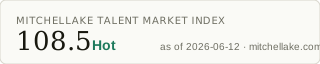
Regional readings use the geo-attributed subset of signals (roughly a quarter of total flow) and measure each region's share of attributed activity. The index updates with each refresh of the underlying signal corpus; figures are point-in-time as of 19 October 2026. The current reading is published as a public JSON summary and an embeddable badge; the full weekly series — confidence intervals included — is free for journalists and researchers via data access.
Methodology changelog
- v1.1 — June 2026. Baseline now excludes the measurement window (computed from the prior complete weeks only). 95% Wilson confidence intervals published on every weekly share and on the headline reading. Directional labels asserted only when the interval on the reading excludes 100.
- v1.0 — initial release. Mix-based weekly hiring balance indexed to the trailing 90-day mean.
Frequently asked questions
What is the MitchelLake Talent Market Index?
The ML-TMI is the headline reading of a live talent-market observatory: a weekly index of global hiring conditions for executive talent. It measures the mix of hiring-positive market signals (capital raising, strategic hiring, geographic expansion, product launches) against hiring-negative signals (layoffs, restructuring) across 157,000+ monitored companies, anchored to a pre-window baseline. The observatory around it adds a weekly narrative, a readings archive, regional and sector gauges, and comparisons against public benchmarks.
How often does the index update?
The underlying data refreshes three times daily (an automated pipeline pulls the signal corpus, recomputes every gauge and republishes the page), and new signals appear on the wire with each refresh. The headline index moves weekly, by construction — it is computed on complete data weeks, so a new reading lands each Monday and intra-week refreshes update the counts, gauges and narrative beneath it.
How is the index calculated?
Signals are classified by hiring polarity. The index is the share of hiring-positive signals among polar signals over the trailing four weeks, indexed to the trailing 90-day baseline — 100 means conditions match trend. Because it measures signal mix rather than volume, it is independent of changes in source coverage.
What does a reading above 100 mean?
Readings above 100 indicate strengthening conditions for executive hiring relative to the 90-day trend; below 100 indicates softening. Labels: 103+ Hot, 100–103 Warm, 97–100 Neutral, below 97 Cool.
Where does the data come from?
The index is computed from MitchelLake's proprietary market-signal dataset, running on Autonodal, the signal-intelligence platform. Autonodal monitors 157,000+ companies across 100+ geographies and 170+ sectors. The read is separately informed by MitchelLake's own relationship graph.
How does the index relate to other market indicators?
The instrument page publishes exploratory cross-correlations between weekly changes in the index and weekly changes in public benchmarks — Indeed job postings (US and Australia), US initial jobless claims, the Dallas Fed Weekly Economic Index and the S&P 500 — at leads and lags of up to three weeks, each with a 95% interval. With the current series length these are transparency artifacts, not claims: the intervals are wide, and none should be read as causal. The archive grows weekly, so the comparisons sharpen over time.
Can I cite or use the index?
Yes — cite it as the "MitchelLake Talent Market Index" with a link to this page, quoting the reading with its 95% confidence interval and methodology version. The current reading is public as a JSON summary at /intelligence/market-health/data.json and as an embeddable badge at /badge.svg; the full weekly series with intervals is free for journalists and researchers with an access key — request one at /data-access.